What does the future of solar cars look like?

Both the German company Sono Motors and the Dutch company Lightyear pushed ahead with the planning for their solar car projects at full speed. Both manufacturers are pursuinga similar goal and have designed electric cars for this purpose, which have solar cells integrated into the outer skin. However, both projects have failed for the time being. However, with the US Aptera and the ZEM concept car, the next models are already ready!
How does a solar car work?
Whe solar cells installed in a photovoltaicsystem convert the sun's energy into electrical power in a solar car . The numbersare built into the body, for example on the car roof or bonnet. The solarmodules generate the electricity while driving and when the car is in the sun. The electricity generated can either be stored in the battery or transmitted directly to the electric motor when driving. In this way, the solar vehicle literally "fills up" with sunshine and thus supports the energy transition.

Lightyear 0 (formerly Lightyear One): A solar car for long distances
Aerodynamic, luxurious and very economical: According to the manufacturer, this is what distinguishes the Lightyear One. Behind this ambitious project arestudents and employees of the Eindhoven University of Technology, which has already gained experience with solar-powered vehiclesEn. Solar Team Eindhoven has participated in and won the World Solar Challenge in Australia several times – with the Stella solar car and several successors.
The Lightyear One with the reinterpreted center console. (©Lightyear)
The Dutch company relieson state-of-the-art and feather-light materials such as aluminum and carbon as well as a streamlined design to make the Lightyear One as economical as possible. With a range of up to 800 kilometres, the solar car should be of particular interest to frequent drivers and long distances.
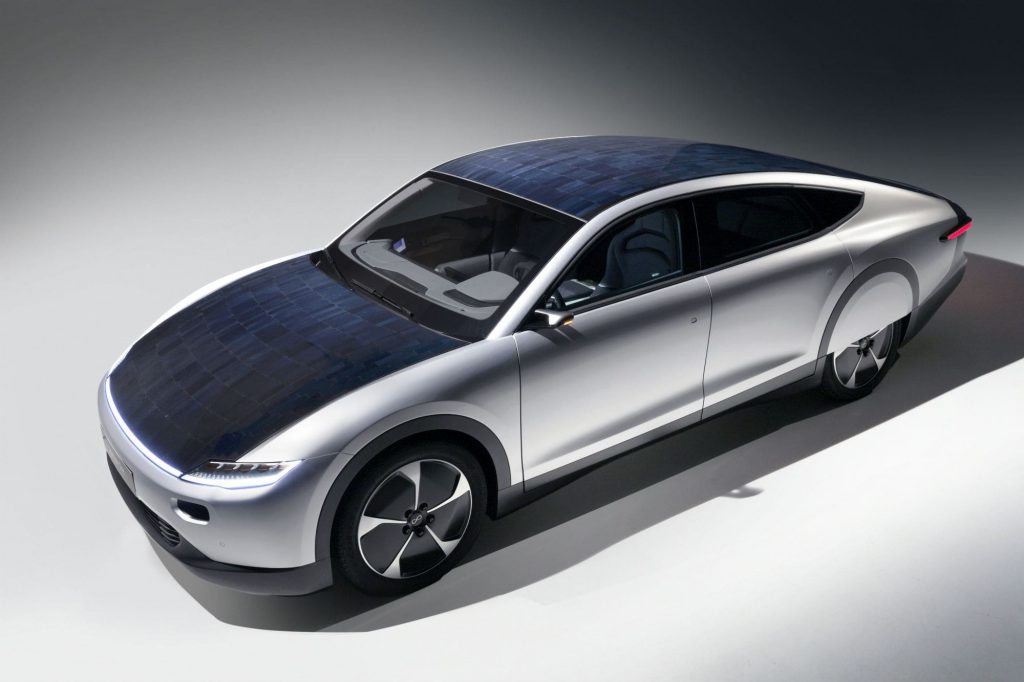
The outer skin of the Lightyear One with the integrated solar cells. (©Lightyear)
After Lightyear had raised money via crowdfunding at the beginning, the financing of the Lightyear One seemed to be secured. Production started in December 2022 in Uusikaupunki, Finland, only to be discontinued in January 2023. The reason: the insolvency of the production company. The umbrella organization then focused on the development of a follow-upmodel, the Lightyear 2. The launch is currently planned for 2025. The solar car is to have a range of 800 kilometers and cost 40,000 euros.
Sion: A solar car for everyone
The Sion stood for the vision of the German manufacturer Sono Motors: of environmentally friendly mobility that has been rethought in many aspects and is open to as many people as possible. The three founders of Sono Motors did not want to build a simple electric car, but to revolutionize mobility:
- The solar cells on the Sion were intended to guarantee independence over short distances, with completely emission-free solar power generated.
- Everything was reduced to the bare essentials and thought out economically: the interior was unfussy, the Sion was to be available in only one colour and without special equipment. In addition, the 54 kWh battery with a range of 305 kilometres (according to WLTP) was only as large as it had to be for average everyday use, according to the manufacturer .
- The idea of sharing was directly considered: an app should be able to offer unneeded electricity from one's own Sion to others. In addition, it should also be easy to search for passengers via the app.
- Sustainability was also a priority in the production of the battery. Critical materials such as cobalt, manganese or nickel should not be necessary.
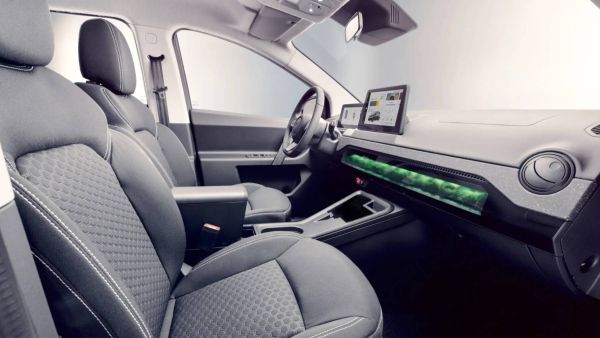
The current interior of the Sion with the moss air filter. (©Sono Motors GmbH)
Sono Motors was founded in Munich in 2016 with this ambitious overall concept. From the very beginning, the founders relied on crowdfunding and the support of people with the same vision. In addition, they disclosed the entire process as well as the financing and wanted the supporters to share in the later profits: The Sion was to be a joint project.
A setback for the company in December 2019 was the missed goal of a major crowdfunding campaign: instead of 50 million euros, it collected only a little more than 30 million euros. But in the extension, which ran until January 20, 2020, Sono Motors was still able to reach the sum of 50 million euros. Nevertheless, the start of production planned for 2021 could not be realized. Production should then start in mid to late 2023, also in Finland. But this did not happen: production was stopped and the project was reduced. In May 2023, the company had to file for bankruptcy, but was able to avert it with a restructuring at the end of February 2024.
Sono Motors decided to focus on its role as a supplier and development partner in the future. Now it can devote itself again to the production of its solar retrofit kits. The company has already made money by equipping trucks of transport companies and buses in public transport with solar panels.
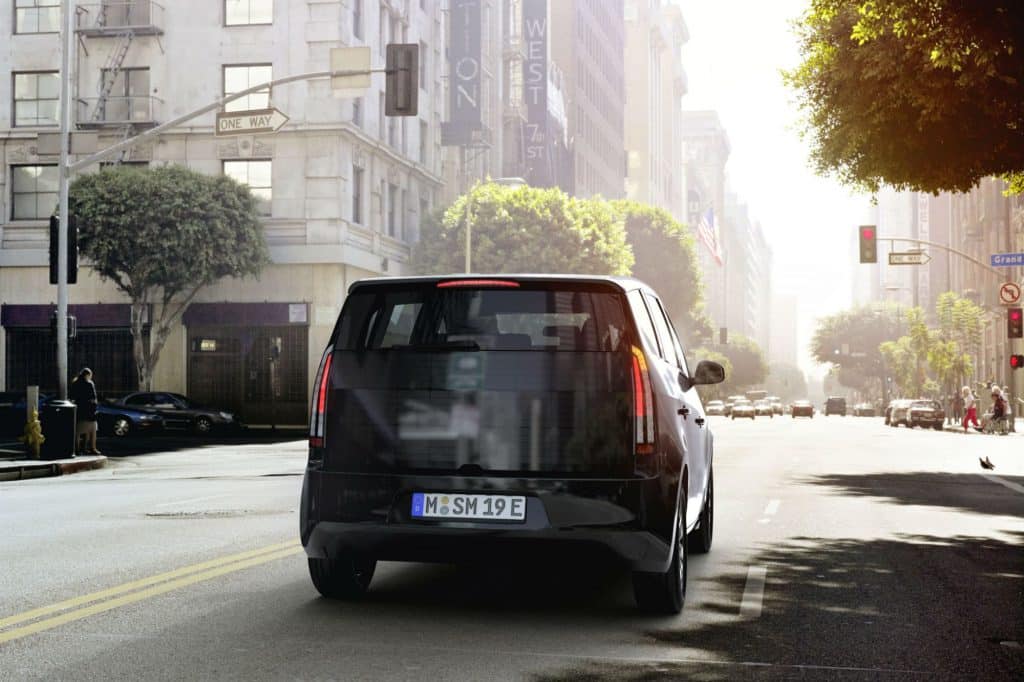
The Sion from Sonor Motors is designed to be practical and suitable for everyday use. (©Sono Motors GmbH)
ZEM concept vehicle: Solar car filters CO2 from the air
Students from the Dutch TU Eindhoven are not only behind the Lightyear One / 0, but also behind the ZEM solar car, which has the appearance of a roadster. The highlight: The concept vehicle filters CO2 from the air at the same time.
After about 320 kilometers, the built-in filter is full. While charging at a charging station, the carbon dioxide can be liquefied and discharged into a tank. If you calculate an annual mileage of 35,000 kilometers, each ZEM solar car can get around two kilograms of CO2 out of the air per year. That doesn't sound like much at first: But extrapolated to millions of electric cars, the air could be relieved by several tens of thousands of tons of CO2 per year.
Around 30 hours were enough for the first draft of the concept vehicle to be ready – an enormous achievement for the students. New methods are also to be used for the production of the solar-powered ZEM car. For example, many body parts could be created using the 3D printing process. In addition, the solar car is designed in such a way that as many parts as possible can be reused or recycled. When and how the concept will continue, however, is still open.
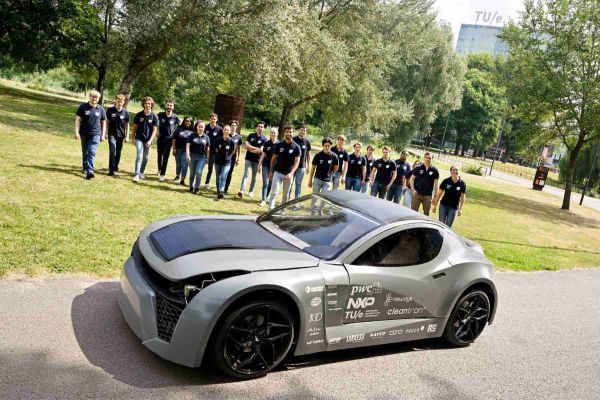
The ZEM solar car was developed by students at Eindhoven University of Technology ( © TU/ecomotive).
Solar car from Aptera: The wind cuts on three wheels
The US manufacturer Aptera is going one step further in development than the solar cars presented so far. With its streamlined shape, lightweight construction and extremely efficient batteries, the solar car is intended to advance into range regions that have so far been almost utopian. Four battery options have been specifically announced:
- 25 kWh for a range of 400 kilometres
- 40 kWh for a range of 650 kilometres
- 60 kWh for a range of 950 kilometres
- 100 kWh for a range of 1,600 kilometres
Aerodynamics are particularly responsible for the long ranges. Because unlike other manufacturers, Aptera does not rely on four, but three (!) Wheels. In addition, there is the power of the solar panels, which were distributed over the body. The manufacturer promises that the curved 700-watt cells can provide up to 64 kilometers of extra range per day under good conditions . In everyday life, this would mean that the electric car would hardly have to be recharged.
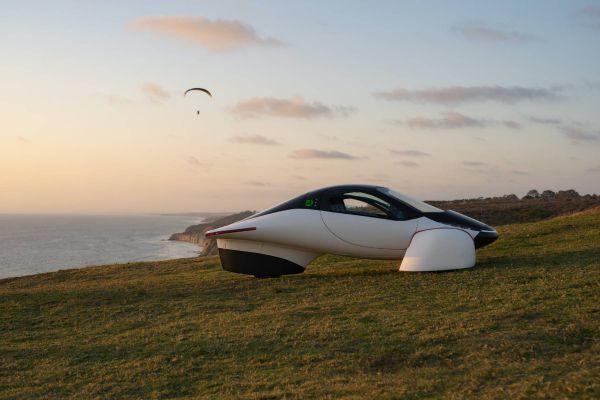
Three wheels and a futuristic body – from the outside, the solar car from the US manufacturer Aptera looks great (© Aptera Motors).
Aptera's solar car in the Launch Edition in the "Lunar Silver" livery is priced at around 33,000 US dollars, although the model is only offered on the US market so far.
In April 2024, the company announced its expansion into the Middle East. To celebrate, a limited edition with gold lacquer was specially designed. It is called "Union Edition" and can be pre-ordered for a deposit of about 25,000 euros. The first solar cars are soon to be delivered in the USA.
Solar cars: advantages and disadvantages of the technology at a glance
Solar-powered vehicles are expected to make the future of automobility more sustainable. The concept brings both positive aspects and challenges.
Advantages of solar cars
- Solar cars are emission-free and very economical.
- Charging with solar energy means that fewer stops at the charging station are necessary, which saves money and time.
- The "refueling" of solar energy costs nothing. It also helps to become less dependent on gasoline prices.
- Solar cars offer a lot of potential, especially in sunny regions.
- Like electric cars, solar-powered vehicles also drive very quietly.
- The concept can also be used for other vehicles such as buses or vans.
Disadvantages of solar cars
- Solar cells are not yet very efficient with an efficiency of 20 percent (in comparison: 85 percent for normal charging and 60 percent for hydrogen).
- Charging via solar energy depends on the weather and season – and is therefore not possible in bad weather conditions.
- Solar energy alone is not enough to run the car. You will need to additionally power it at the charging station.
- Since solar-powered vehicles cannot charge in garages or carports, they should be placed in the open air.
Conclusion: Solar cars as the future of e-mobility?
While the ZEM and Aptera's solar car are still concept vehicles and studies respectively, Lightyear and Sono Motors have already failed with their projects. What united the two manufacturers was the common goal of taking solar cars out of their niche and demonstrating their advantages. The question remains why hardly any of the major manufacturers have so far oriented themselves in the direction of solar cars. The reason is probably that the corresponding technology has yet to be developed and designed in such a way that the finished vehicles are also attractive to customers. This will take several more years. The solar cells used on house roofs cannot simply be mounted on an electric car. Hyundai has already developed the first electric cars with an optional solar roof with the Genesis Electrified G80 and IONIQ 5 models . According to the manufacturer, these should offer an additional range of up to 2,000 kilometers per year.
Until the development of solar cars is fully mature, drivers can also use charging their e-cars with electricity from their home solar system – via their own wallbox – for the time being.