Hydraulic balancing: This is how easy it is to save costs and energy when heating

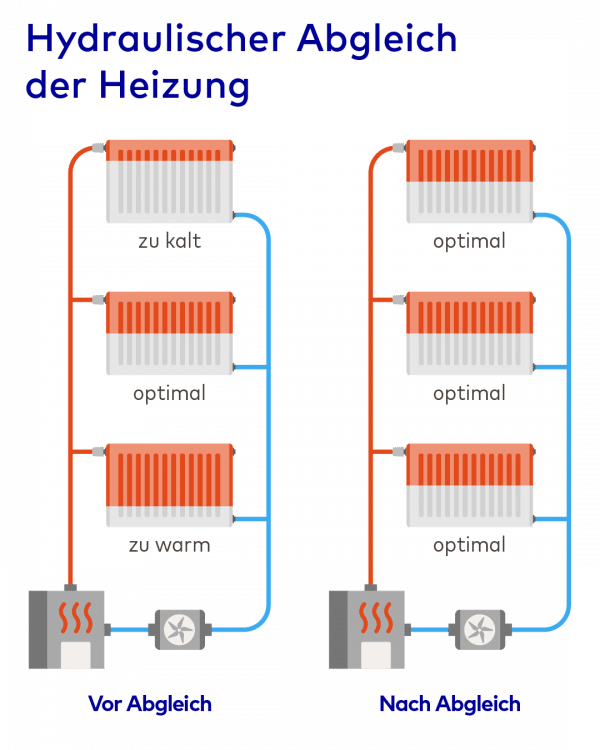
The radiator in the kitchen is already glowing, while it is still icy cold in the bathroom despite the heating turned up? In this case, hydraulic balancing can be the solution. We'll tell you what's behind it.
What is hydraulic balancing and when is it necessary?
If the radiators in the building are heated differently or if there are difficulties in regulating the room temperatures, hydraulic balancing is necessary. Your heating system uses a system of pipes that are located at different distances from the central boiler. That's why the water pressure is higher in some rooms and lower in others. In addition, the boilers closer to the radiator are supplied with hot water first, while the radiators further away are heated more slowly.
This in turn means that some rooms are heated better than others.
If you then set the heating too high to heat the supercooled rooms quickly, this can lead to unnecessary energy costs. Increasing the pump capacity or flow temperature does not solve the actual problem either, but also leads to rising costs. In addition, there may be disturbing flow noises such as loud whistling or gurgling.
Hydraulic balancing is the solution to the problem. The hot water inflow is regulated by adjusting the valves, pumps and pipes of the heating system so that all radiators are supplied with exactly the amount of water needed to heat the room at the desired temperature.
This measure has several advantages. On the one hand, all rooms in your home are heated evenly and energy-efficiently. In addition, the flow temperature of the heating can often be lowered after hydraulic balancing. Ahydraulically balanced heating system consumes significantly less energy and you reduce your heating costs.
The principle of hydraulic balancing is based on the fact that the water in the heating system always takes the path where the resistance is lowest. As a result, radiators that are further away from the boiler often do not heat up properly, while those near the boiler become too hot. With hydraulic balancing, the heating system is adjusted so that the heat is evenly distributed throughout the house.
Is ahydraulic adjustment mandatory?
Two legal regulations will apply from January to September 2024 for heating optimisation in buildings with a gas central heating system.
EnSimiMaV Ordinance: Buildings with gas central heating and at least ten residential units had to be hydraulically balanced by 30 September 2023. In addition, this measure is also to be implemented in buildings with at least six residential units by September 15, 2024.
Amended Building Energy Act (GEG) in January 2024: Owners of larger residential buildings with at least six residential units are obliged to have their older heating systems checked and, if necessary, optimised. This also includes – if it has not yet been carried out – hydraulic balancing. The check also applies to heating systems installed after 30 September 2009. It must take place no later than 15 years after installation, with the deadline being 30 September of the following year. According to the GEG, the cut-off date for 2024 is therefore 30 September.
To increase efficiency and reduce energy consumption, older heating systems must also be tested by 30 September 2027. If buildings are larger and have six or more residential units, method B is mandatory for hydraulic balancing. Meanwhile, this is not mandatory for smaller houses or detached and semi-detached houses. However, subsidies are possible for the implementation of a comparison.
If heating systems have been newly installed, hydraulic balancing will be mandatory in buildings with more than six usage units and water as a heat transfer medium from 1 January 2024.
Can I perform hydraulic balancing myself?
Hydraulic balancing should be carried out by a professional if possible, because determining the relevant values is not easy. The reason: There are many different factors that have a decisive influence on the optimal amount of water. Plant mechanics for sanitary, heating and air conditioning technology, gas and water installers as well as central heating and ventilation engineers can usually carry out hydraulic balancing.
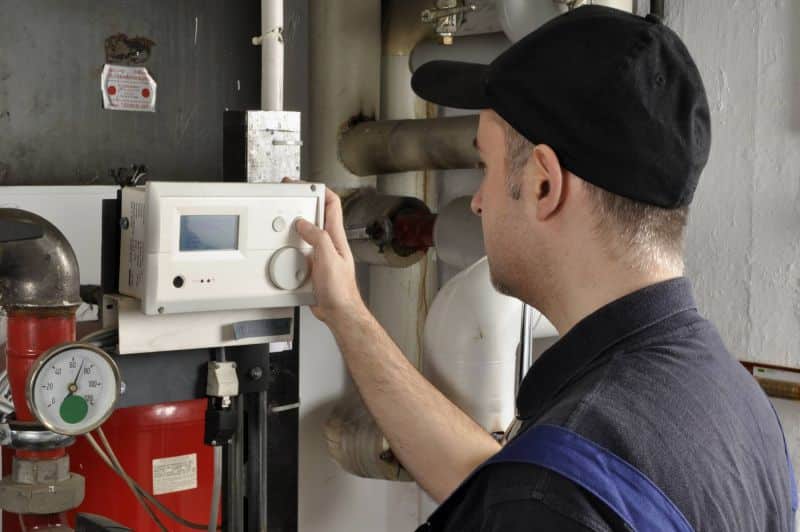
We recommend that a hydraulic balancing is carried out by a professional.
How does hydraulic balancing work?
But what exactly is done during hydraulic balancing?
With hydraulic balancing, the heating system is optimized so that each room reaches the desired temperature by evenly distributing the heat in the house.
Zunächst analysiert ein Fachbetrieb die unterschiedlichen Faktoren, die den Wärmebedarf jedes Raums beeinflussen. Zu diesen Faktoren zählen zum Beispiel
- die Dämmung der Außenwände
- die Qualität der Fenster
- Lüftungsverhalten
- Verluste von Wärme über Fußboden und Decke
Basierend auf dieser Analyse berechnet man die Heizlast für jeden Raum, sprich: die zur Aufrechterhaltung einer bestimmten Temperatur benötigte Wärmemenge. Im nächsten Schritt folgt die Berechnung der erforderlichen Heizwassermenge und Pumpenleistung je Raum. Dafür berücksichtigt man auch die Entfernung der Heizkörper zur Heizungspumpe, damit ausreichend Warmwasser zu jedem Heizkörper gelangt.
Zu guter Letzt muss noch das Thermostatventil am jeweiligen Heizkörper entsprechend eingestellt werden, um eine gleichmäßige Wärmeverteilung zu erreichen.
Dank der exakten Einstellung der Heizungsanlage vermeidet man überflüssige Energieverluste und optimiert den Wohnkomfort in den Räumen. Ein hydraulischer Abgleich steigert also die Effizienz der Heizungsanlage und hilft die Umweltbelastung zu reduzieren.
Procedures A and B
Beim hydraulischen Abgleich unterscheidet man zwischen dem vereinfachten Verfahren A und dem genaueren Verfahren B. Bis Ende 2022 wendete man vor allem Verfahren A an. Seit Januar 2023 ist aber laut Gebäudeenergiegesetz (GEG) das Verfahren B verpflichtend, um eine Förderung für den hydraulischen Abgleich zu bekommen.
Der größte Unterschied der beiden Verfahren ist die Genauigkeit bei der Identifizierung des Heizbedarfs der einzelnen Räume, also der Heizlast. Bei kleineren und weniger komplexen Heizsystemen wie Einfamilienhäusern oder kleinen Mehrfamilienhäusern kommt vor allem Verfahren A zur Anwendung. Es basiert auf standardisierten Werten für die Bestimmung der Heizlast. Diese wird anhand allgemeiner Faktoren wie Raumgröße und Raumtyp geschätzt. Heizkörperventile und Pumpenleistung reguliert man anhand vordefinierter Werte, die oft auf Erfahrungswerten beruhen. Während das Verfahren einfach und kostengünstig ist, berücksichtigt es nicht die individuellen Raumeigenschaften.
Unterdessen kommt Verfahren B für detailliertere und präzisere hydraulische Abgleiche zum Einsatz. Die Analyse umfasst dabei individuelle Raumfaktoren wie Größe, Dämmung, Fensterflächen und äußere Bedingungen. Durch exakte Berechnungen und Messungen ermittelt man die benötigte Heizlast für jeden Raum und kann so eine optimale Einstellung von Ventilen und Pumpenleistung gewährleisten. Verfahren B eignet sich insbesondere für größere und komplexere Heizsysteme und kann zu erheblichen Energieeinsparungen beitragen.and can contribute to significant energy savings.
How much does hydraulic balancing cost?
It is not possible to put an exact figure on how much hydraulic balancing costs. It is a freely offered service. For this reason, prices can also differ greatly from region to region. It is also crucial how well your heating system is in good condition and how it is constructed. If the system uses a modern heating pump, the costs are usually lower than with an old system. In addition, it also plays a role which thermostatic valves are used and whether method A or B is used.
If only the hydraulic balancing including a replacement of the thermostatic valves is carried out, you must expect costs of 650 to 1,250 euros for an average single-family house (EFH).
However, the financial outlay for hydraulic balancing is significantly higher in large buildings with many radiators. If older heating systems do not have pre-adjustable thermostatic valves, they may have to be retrofitted, which will result in further costs.
If the heating pump is also to be replaced at the same time , costs of around 400 euros are added. However, when replacing the heating pump, the annual savings potential is also greater. While a hydraulic balancing including the replacement of the thermostatic valves is expected to result in savings of 75 euros per year, an additional replacement of the heating pump can reduce heating costs by up to 190 euros.
Investing in hydraulic balancing is worthwhile in the long term because of the considerable savings potential in the event of rising energy prices.
Hydraulic balancing conveyor
However, anyone interested in hydraulic balancing does not have to bear the costs completely alone. As part of the "Federal Funding for Efficient Buildings" (BEG), 15 percent of the total costs of heating optimization, which also includes hydraulic balancing, are subsidized. However, the heating system must be at least two years old. Heating systems that are operated with fossil fuels must not be older than twenty years.
The subsidy can be applied for at the Federal Office of Economics and Export Control (BAFA).
If a subsidized individual renovation roadmap also includes hydraulic balancing as a component, even 20 percent funding is possible. In addition to funding for hydraulic balancing, a subsidy for the replacement of heating pumps can also be applied for through the BEG.
Receive a state subsidy for hydraulic balancing
- Individuals
- Enterprise
- Municipalities and associations
- Foundations
- Non-profit organisations and cooperatives for buildings with up to five residential units or with a heated area of no more than 1000 square metres (non-residential buildings)
The application to the Federal Office of Economics and Export Control (BAFA) is the same in each case:
- Obtaining an offer for the respective measure from the specialist company (However, the order may not yet be placed, otherwise no funding is possible.)
- Obtain information about the BAFA information sheet and fill out the application form
- Activate portal access after receiving a confirmation email
- Once the grant notice has been received by post, the specialist company can be commissioned
- Submit proof of use via the BAFA portal no later than 6 months after the end of the approval period.
In any case, you will initially have to bear the costs of hydraulic balancing yourself and will only receive funding from the state later.
Why hydraulic balancing can make sense is briefly explained again in the following video by an expert from the "#CLEVERLÄND – Saving Energy Together" initiative of the state of Baden-Württemberg:

Hydraulic balancing for underfloor heating
To optimize your heating, hydraulic balancing is undoubtedly an effective measure. This also applies if your home is equipped with underfloor heating. This is because rooms with large underfloor heating circuits are often supplied with an insufficient amount of water by the heating system. As a result, the corresponding pump must deliver significantly more power than necessary.
Signs of the need for hydraulic balancing of your underfloor heating include:
- Underfloor heating does not heat up evenly, especially in certain areas.
- Although the heating is on, some rooms do not get as warm as desired.
- Regulating or lowering the temperature is difficult with underfloor heating.
- The power consumption of the heating pump is unusually high.
- In order to achieve the desired heat, you have to significantly increase the flow temperature of the heater.
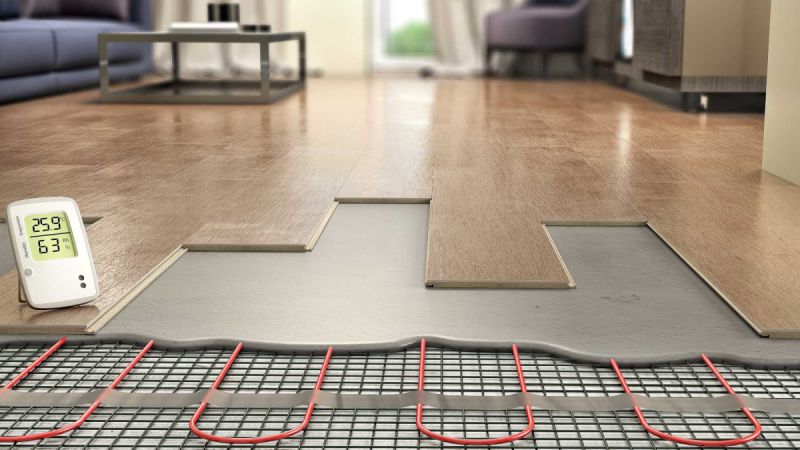
If your underfloor heating is only working properly after a long delay or no longer works at all, hydraulic balancing is necessary
Hydraulic balancing for underfloor heating also requires some arithmetic work and should be carried out by a specialist company if possible. First of all, the number of heating circuit distributors and heating circuits must be determined and the heating load calculated. Then the amount of water required must be ascertained. Now only the heating circuit distributor has to be configured accordingly, provided that it is equipped with flexibly adjustable valves. Et voilà: All rooms with underfloor heating should now be heated evenly.
The hydraulic balancing of underfloor heating requires a considerable additional effort, which is reflected in higher costs. Depending on how large the system is, homeowners can incur costs of between 500 and 1550 euros.
By the way: Incorrect ventilation and heating can also lead to high energy costs. When you buy a new radiator, you should determine the required heating power and size of the radiator in advance. With our Heating and ventilation tips will save you money. Why an electric fan heater is not an alternative to heating, we have compiled for you in another article.